
 Search
{{#data.error.root_cause}}
{{/data.error}}
{{^data.error}}
[{{{type}}}] {{{reason}}}
{{/data.error.root_cause}}
{{#data.hits.hits}}
{{#_source.featured}}
FEATURED
{{/_source.featured}}
{{#_source.showImage}}
{{#_source.image}}
 {{/_source.image}}
{{/_source.showImage}}
{{/data.hits.hits}}
{{{_source.title}}} {{#_source.showPrice}} {{{_source.displayPrice}}} {{/_source.showPrice}}
{{#_source.showLink}} {{/_source.showLink}} {{#_source.showDate}}{{{_source.displayDate}}}
{{/_source.showDate}}{{{_source.description}}}
{{#_source.additionalInfo}}{{#_source.additionalFields}} {{#title}} {{{label}}}: {{{title}}} {{/title}} {{/_source.additionalFields}}
{{/_source.additionalInfo}}Anti-HSP70/HSC70 | Heat shock protein 70/Heat shock cognate protein 70 (serum)
(Cat#: AS05 083)

Description
- Immunogen: KLH-conjugated synthetic peptide conserved across all known sequences of HSP70 P08107 and HSC70 proteins P11142
- Host: Rabbit
- Clonality: Polyclonal
- Purity: Total IgG. Protein G purified in PBS pH 7.4.
- Format: Lyophilized
- Quantity: 100 µl
- Reconstitution: For reconstitution add 100 µl of sterile water
- Storage: Store lyophilized/reconstituted at -20°C; once reconstituted make aliquots to avoid repeated freeze-thaw cycles. Please remember to spin the tubes briefly prior to opening them to avoid any losses that might occur from material adhering to the cap or sides of the tube.
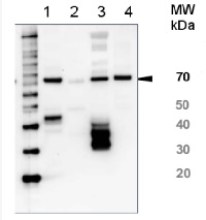
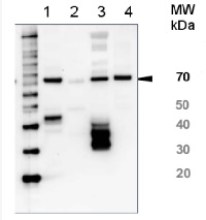
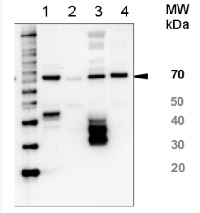
- Tested applications: Immunoprecipitation (IP), Western blot (WB)
- Recommended dilutions: 1 : 1000 (IP), 1 : 1000-1: 5000 (WB)
- Expected | apparent MW: 70 kDa
- Confirmed reactivity: Fish, mammals, fungi: Antrodia infirma, A. sinuosa, A. xantha, Catostomus commersonii, Gloeophyllum protractum, Gloeophyllum sepiarium, G. carbonarium, Junghunia luteoalba, Oligoporus sericiomollis, Phlebia cornea
- Not reactive in: No confirmed exceptions from predicted reactivity are currently known
- Heat shock protein 70 (Hsp70) is the major stress-inducible protein in vertebrates and is highly conserved throughout evolution. It plays a role as a molecular chaperone and is important for allowing cells to cope with acute stress or insult, especially those affecting the protein machinery. Heat shock cognate protein 70 (HSC70) is a highly conserved protein and a member of the family of molecular chaperones. Alternative names: HSP70.1, HSP70-1/HSP70-2, Heat shock 70 kDa protein 8
- MacLellan et al. (2015). Chaperone roles for TMAO and HSP70 during hyposmotic stress in the spiny dogfish shark (Squalus acanthias). J Comp Physiol B. 2015 Jun 7.
- Bessemer et al. (2014). Cardiorespiratory toxicity of environmentally relevant zinc oxide nanoparticles in the freshwater fish Catostomus commersonii. Nanotoxicology. 2014 Nov 27:1-10.
- Gorovits et al. (2013). Recruitment of the host plant heat shock protein 70 by tomato yellow leaf curl virus coat protein is required for virus infection. PLoS One, July 23;8(7).
- Peláez et al. (2025). Harnessing macroalgal cell walls to trigger immunity in Arabidopsis thaliana. Plant Stress. 2025; (15): 100783.
- For detection of plant and algal cytoplasmic hsp70 we recommend following product: AS08 371.