
 Search
{{#data.error.root_cause}}
{{/data.error}}
{{^data.error}}
[{{{type}}}] {{{reason}}}
{{/data.error.root_cause}}
{{#data.hits.hits}}
{{#_source.featured}}
FEATURED
{{/_source.featured}}
{{#_source.showImage}}
{{#_source.image}}
 {{/_source.image}}
{{/_source.showImage}}
{{/data.hits.hits}}
{{{_source.title}}} {{#_source.showPrice}} {{{_source.displayPrice}}} {{/_source.showPrice}}
{{#_source.showLink}} {{/_source.showLink}} {{#_source.showDate}}{{{_source.displayDate}}}
{{/_source.showDate}}{{{_source.description}}}
{{#_source.additionalInfo}}{{#_source.additionalFields}} {{#title}} {{{label}}}: {{{title}}} {{/title}} {{/_source.additionalFields}}
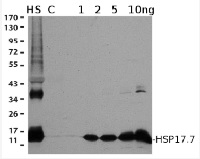
{{/_source.additionalInfo}}Anti-HSP17,7 | Cytosolic class II heat shock protein 17,7
(Cat#: AS07 255)
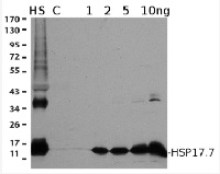
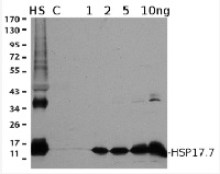
Description
- Immunogen: Full-length recombinant protein produced in E. coli and purified by conventional methods (no affinity tag). Arabidopsis thaliana Hsp17.7 CII (class two), UniProt: O81822, TAIR: At5g12030
- Host: Rabbit
- Clonality: Polyclonal
- Purity: Serum
- Format: Lyophilized
- Quantity: 50 µl
- Reconstitution: For reconstitution add 50 µl of sterile water
- Storage: Store lyophilized/reconstituted at -20°C; once reconstituted make aliquots to avoid repeated freeze-thaw cycles. Please remember to spin the tubes briefly prior to opening them to avoid any losses that might occur from material adhering to the cap or sides of the tube.
- Tested applications: Western blot (WB)
- Recommended dilutions: 1 : 1000 (WB)
- Expected | apparent MW: 17.7 kDa
- Confirmed reactivity: Arabidopsis thaliana, Agave tequiliana var. Weber, Cucumis sativus, Medicago sativa, Pinellia ternata, Silene vulgaris
- Not reactive in: Oryza sativam, Polyscias elegans
- Hsp17.7 belongs to a family of class II of a small heat shock proteins. They are induced once a plant cells are stressed by an increased temperature. The way small hsp proteins are protecting a living cell are not fully understood. They seem to be involved in chaperone functions by protecting other proteins from irreversible denaturation. Small hsp function also in a late seed maturation process.
- Cha et al. (2020). Humic acid enhances heat stress tolerance via transcriptional activation of Heat-Shock Proteins in Arabidopsis. Sci Rep. 2020 Sep 14;10(1):15042.doi: 10.1038/s41598-020-71701-8. McLoughlin et al. (2019) HSP101 Interacts with the Proteasome and Promotes the Clearance of Ubiquitylated Protein Aggregates. Plant Physiol. 2019 Aug;180(4):1829-1847. doi: 10.1104/pp.19.00263Fu et al. (2019). Increased fes1a thermotolerance is induced by BAG6 knockout. Plant Mol Biol. 2019 Feb 22. doi: 10.1007/s11103-019-00844-8.Korotaeva et al. (2018). Effect of Heat Hardening on Expression of Genes phb3 and phb4 and Accumulation of Phb Proteins in Green Leaves of Arabidopsis thaliana. Russian Journal of Plant Physiology, 65(5), 688-696, 2018. https://doi.org/10.1134/s1021443718040039McLoughlin et al. (2016) Class I and II Small Heat Shock Proteins Together with HSP101 Protect Protein Translation Factors during Heat Stress. Plant Physiol. 2016 Oct;172(2):1221-1236.